By Ahvia Designs | Gauteng, South Africa | Published June 2026
South African homes are in the middle of a quiet revolution. After years of trend-chasing, the all-white kitchen, the grey-on-grey palette, and the Instagram-perfect staged living room, homeowners in Gauteng and beyond are reclaiming something more personal. More textured. More grounded.
The interior design trends defining South African homes in 2026 are not driven by what looks good in a photo. They are driven by how a space feels to live in. By warmth, authenticity, and the kind of considered craftsmanship that outlasts a season.
This guide breaks down the eight trends shaping residential interior design across South Africa this year, what they look like in practice, how they translate to different rooms, and how Ahvia Designs is interpreting them for clients in Johannesburg, Pretoria, and the broader Gauteng area.
The defining shift in South African interior design for 2026: spaces are no longer designed to impress. They are designed to restore. The most sophisticated homes of the year are the ones that feel genuinely lived-in – considered, not curated for an audience.
Interior Design Trends for South African Homes in 2026: At a Glance
Here is a summary of the eight defining trends. We unpack each one in full below.
| Trend | What it looks like in practice | Best applied to |
| Warm minimalism | Earthy palettes, natural materials, uncluttered but lived-in | Living rooms, bedrooms |
| Tactile textures | Bouclé, linen, reclaimed timber, artisanal tiles | Lounges, bathrooms, kitchens |
| Biophilic design | Indoor plants, natural stone, organic shapes, water features | All rooms, especially living & bathrooms |
| Indoor-outdoor flow | Continuous flooring, folding doors, outdoor kitchens | Open-plan homes, patios |
| Sculptural lighting | Statement pendants, layered warm light, reconfigurable systems | Dining rooms, kitchens, entrance halls |
| Colour drenching | Single colour across walls, ceiling and joinery | Feature rooms, studies, bathrooms |
| Local artisan touches | Handcrafted furniture, SA-made tiles, woven textiles | Throughout — especially living & dining |
| Curved architecture | Arched doorways, rounded islands, curved built-ins | Kitchens, entrance halls, living rooms |
1. Warm Minimalism: The End of Cold Interiors
The cold, clinical minimalism that dominated South African interiors through the early 2020s is giving way to something far more liveable. Warm minimalism keeps the uncluttered discipline of its predecessor, but swaps grey concrete, chrome fixtures, and stark white walls for earthy ochres, raw linens, burnished timbers, and matte terracotta.
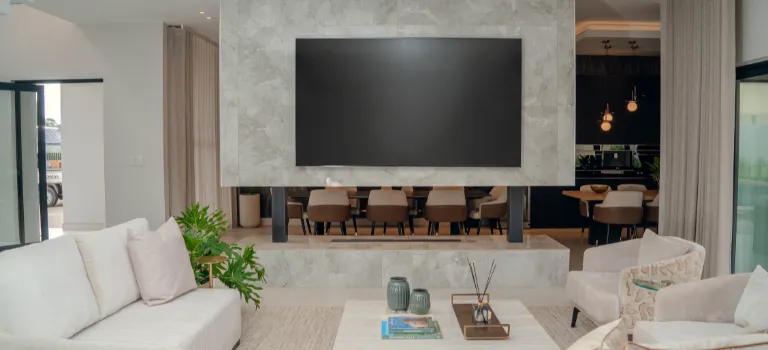
The palette draws from the South African landscape itself: the warm tones of Highveld grassland, the dusty pinks of Northern Cape rock, the deep greens of coastal fynbos. These colours feel locally appropriate in a way that imported trend palettes rarely do, which is part of why they are resonating so strongly with homeowners this year.
How to apply it: Swap bright white walls for a warm off-white or sandy linen tone. Replace chrome hardware with brushed brass or aged bronze. Layer natural materials – timber, stone, woven jute – rather than relying on a single statement piece.
Ahvia Designs’ perspective: Warm minimalism works particularly well in open-plan homes where strong summer light can make cooler palettes feel harsh. Earthy tones absorb and soften that light beautifully.
2. Tactile Textures: Designing for Touch, Not Just Sight
If 2026 has a signature material story, it is this: surfaces that reward touch. Bouclé upholstery. Rough-hewn stone basins. Handmade tiles with deliberate variation. Linen curtains that pool softly on the floor. Reclaimed timber with visible grain.
This shift reflects something deeper than aesthetics. In an era of digital saturation, there is a growing desire for the physical, the imperfect, and the handmade. South African homeowners are increasingly drawn to materials with provenance, pieces that bear the maker’s fingerprints.
In practice, this trend manifests differently across rooms:
- Bathrooms: fluted stone basins, handmade mosaic tiles, honed marble rather than polished
- Kitchens: raw timber open shelving, hand-thrown ceramic hardware, matte stone countertops
- Living rooms: bouclé sofas, jute or wool rugs, plaster walls with visible texture
- Bedrooms: linen bedding, woven bedheads, aged brass bedside fittings
How to apply it: You do not need to redecorate an entire room to introduce texture. A single bouclé armchair, a handmade ceramic lamp base, or a textured wallcovering on one wall delivers the same effect with far less disruption.
3. Biophilic Interior Design: Bringing the Outside In
Biophilic design, the practice of integrating natural elements into interior spaces, is no longer a niche concept. It has become a defining principle of residential interior design in South Africa, and its influence is visible across every room category in 2026.
At its core, biophilic design is about connection to the natural world. That connection takes many forms in practice:
- Large-scale indoor plants integrated into the architecture of a room, not placed as an afterthought
- Natural stone is used as a primary surface material: walls, floors, and countertops, rather than a decorative accent
- Organic shapes in furniture: curves, irregular edges, forms that echo natural rather than manufactured geometry
- Water features used as acoustic and visual elements, particularly in entrance halls and outdoor transitions
- Maximised natural light through larger window openings and light-directing architectural details
South African designers are particularly well-positioned to authentically interpret biophilic principles. Our landscape is extraordinary, and 2026 is the year that more homes are consciously designed to reference it.
The most compelling biophilic interiors in South Africa are not botanical gardens transplanted indoors. They are spaces where the material language of the room – stone, timber, plaster, linen – echoes the natural environment outside the window.
4. Indoor-Outdoor Living Design: A Trend South Africa Has Always Been Primed For
South Africa’s climate is arguably the greatest single advantage any homeowner on this continent has over their northern hemisphere counterparts. The interior design trends for South African homes in 2026 are making full use of it.
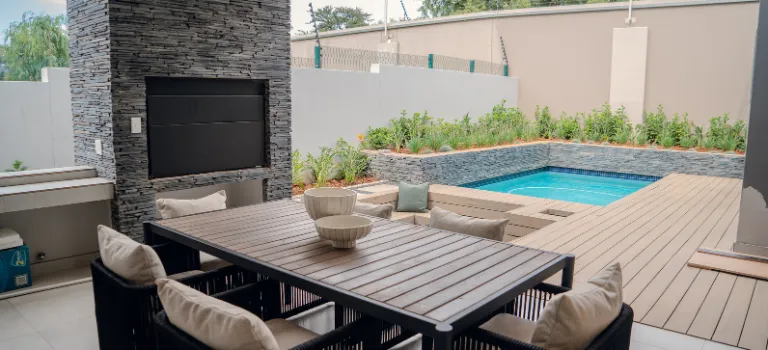
Indoor-outdoor living design, the deliberate blurring of the boundary between interior and exterior space, is accelerating rapidly. It is no longer enough to have a sliding door onto a patio. The most compelling homes of 2026 treat the outdoor living area as a fully designed room: with weather-appropriate upholstery, outdoor kitchens, landscaped dining zones, fire features, and lighting that extends the usable space well into the evening.
Key design moves driving this trend:
- Continuous flooring materials used inside and out – the same stone or large-format porcelain tile flowing from living room to terrace creates a seamless visual and spatial connection
- Large folding or sliding door systems that, when open, remove the physical threshold entirely
- Covered pergola or louvred roof structures that make outdoor spaces usable year-round
- Outdoor kitchens with built-in braai, prep surfaces, and refrigeration – not just a standalone Weber on a wooden deck
- Landscape design integrated with the architecture of the home – not treated as a separate project
How to apply it: The single most impactful change in an existing home is flooring continuity. Using the same tile or stone from inside to outside, even if the material specification changes slightly for weather-resistance, immediately reads as a designed, intentional space rather than an afterthought.
5. Sculptural Lighting: Where Function Meets Art
Lighting in South African homes is undergoing a fundamental rethink. The recessed downlight grid – ubiquitous, functional, and deeply uninteresting – is being displaced by layered, adaptive, and architecturally considered lighting design.
In 2026, the most significant interior design trend in lighting is sculptural. Pendants are no longer decorative accessories; they are the primary visual statement of a room. Dining room pendants are growing in scale, in material complexity, and in presence. Entrance hall chandeliers are returning, not in their traditional ornate form, but reinterpreted in blackened steel, handblown glass, and natural materials.
Beyond the statement fixture, the more substantive shift is toward layered lighting systems:
- Warm ambient lighting via wall sconces and floor lamps, not overhead fixtures
- Task lighting integrated invisibly into cabinetry and joinery
- Accent lighting that highlights architectural features, artwork, or material finishes
- Human-centric lighting that adjusts colour temperature throughout the day
Designer note: Lighting is the element most often left to an electrician rather than a designer, and it is the single most common source of post-renovation disappointment. The right light specification, integrated into the design from the outset, transforms how every other element reads.
6. Colour Drenching and Bold Bathroom Design
After years of cautious, neutral palettes, South African homeowners are finding their courage with colour in 2026, particularly in rooms where the stakes feel lower. Bathrooms and studies are leading the charge.
Colour drenching, the technique of applying a single colour to all surfaces in a room, including walls, ceiling, woodwork, and joinery, is one of the most striking interior design trends South African homes are adopting this year. Done correctly, it creates an immersive, cocoon-like effect that feels both bold and surprisingly calming.
The colours gaining traction in South African interiors reflect the global shift toward depth and personality:
- Deep forest green – particularly in bathrooms and home offices
- Dusty rose and terracotta – in bedrooms and informal dining
- Aged navy and inky blue – in studies, libraries, and feature walls
- Warm mushroom and clay – for rooms where calm is the priority
Bathroom design in 2026 is also seeing a revival of mosaic and small-format tiles, a significant departure from the large-format porcelain that dominated the previous decade. Handmade ceramic tiles with variation in glaze and finish are appearing in bathrooms, kitchen splashbacks, and as decorative wall panels.
How to apply it: If full colour drenching feels too committed, start with a bathroom. The contained room scale makes it the ideal space to experiment with a deep, saturated tone. A forest green bathroom with aged brass fixtures and a stone basin is one of the most elegant interior design moves of the year.
7. South African Artisan Design: The Local Advantage
One of the most meaningful interior design trends for South African homes in 2026 is not imported from Milan or Scandinavia. It is emerging from craft studios in the Western Cape, ceramicists in Johannesburg, and furniture makers using reclaimed indigenous timber across the country.
South African-made design is having a defining moment. Homeowners are actively seeking out locally crafted furniture, handmade tiles, woven textiles, and artisanal accessories, not merely as an act of patriotism, but because the quality, distinctiveness, and character of locally produced design are genuinely exceptional.
What does this look like in residential interior design practice?
- Custom furniture commissions from South African makers – pieces designed for the specific proportions of the room rather than selected from a catalogue
- Handmade ceramic basins, vases, and tableware as anchoring decorative objects
- Woven textiles – wall hangings, rugs, throws – that reference South African craft traditions
- Reclaimed yellowwood and stinkwood repurposed into contemporary furniture and joinery
- Mosaic and hand-painted tiles made by South African artisans for bathrooms and kitchen splashbacks
At Ahvia Designs, we actively incorporate South African-made pieces into our residential projects wherever possible. The result is not just a more distinctive interior. It is a home with a sense of place and provenance that mass-produced furnishing cannot replicate.
8. Curved Architecture and Soft Forms
The sharp right angle is softening. Curved architectural elements, arched doorways, rounded kitchen islands, gently bowed built-in cabinetry, and circular skylights are frequently appearing across residential interior design in South Africa in 2026.
This is not a superficial decorative trend. The appeal of curved forms is psychological as much as it is aesthetic. Soft, rounded shapes reduce the visual tension in a room. They make spaces feel more welcoming, more organic, and more naturally proportioned, particularly in the open-plan layouts that dominate modern South African home design.
The most successful applications of this trend are architectural rather than merely decorative:
- Arched thresholds between rooms – replacing the standard square opening with a softer, more inviting transition
- Rounded kitchen islands – particularly effective in large open-plan kitchens where a rectangular island can feel rigid and institutional
- Curved built-in benches in dining areas – creating a sense of enclosure and intimacy
- Barrel-vaulted ceilings in entrance halls, studies, and wine cellars
How to apply it: The lowest-cost entry point for this trend is an arched doorway. Converting a standard rectangular opening to a soft arch is a relatively straightforward structural change that has an outsized visual impact on the feel of a home.
How to Apply These Interior Design Trends in Your South African Home
Understanding a trend and knowing how to apply it in a real home are two different things. Here is how to approach the 2026 interior design landscape practically:
Start with the trends that serve your lifestyle, not your Instagram
Not every trend is right for every home or every household. A family with young children and a working farm needs a different interior design approach than a professional couple in a Sandton penthouse. The most enduring interiors in 2026 are the ones designed around how the people in them actually live, not around what’s circulating on Pinterest.
Invest in materials, not moments
The trends gaining the most traction in South Africa this year – tactile textures, natural materials, locally crafted pieces – all share a common quality: they improve with age. Investing in high-quality materials and considered craftsmanship produces an interior that becomes more beautiful over time, rather than one that dates with the next trend cycle.
Treat each room as part of a whole
The most common mistake in home renovation is designing rooms in isolation. A bathroom renovation that ignores the material language of the adjacent bedroom, or a kitchen redesign that disconnects from the living area it flows into, produces a home that feels incoherent regardless of how well each individual room is executed. Residential interior design in Gauteng, done well, treats the home as a single interconnected experience.
Work with a professional interior designer from the outset
The complexity and cost of a renovation, and the number of irreversible decisions made early in the process, make professional design guidance one of the highest-return investments a homeowner can make. A professional interior designer brings not only aesthetic and materials knowledge but also spatial expertise, supplier access, and project management, thus preventing costly mistakes that derail self-managed renovations.
Bring the 2026 Interior Design Trends to Life in Your Gauteng Home
At Ahvia Designs, we interpret every residential project through the lens of how our clients actually live – informed by the best of South African and international design thinking, grounded in local climate, culture, and craftsmanship.
Whether you are planning a full home renovation, a bathroom redesign, a kitchen transformation, or an outdoor living upgrade, we bring every stage of the design process, from the initial consultation and 3D visualisation through to procurement, project management, and final styling, under one trusted team.
Ready to bring these interior design trends to life in your South African home? Book a free consultation with Ahvia Designs today. Call 083 926 1669 or visit our website.