By Ahvia Designs | Gauteng, South Africa | Bathroom Design & Renovation
You stand at your bathroom door and feel it before you even step inside. The room is too small, too dark, too cluttered. The toilet crowds the basin. The shower barely fits. There is nowhere to put anything, and no matter how clean it is, it never feels quite right.
This is the reality of most South African bathrooms, particularly in townhouses, cluster developments, and older suburban homes where bathroom square footage was not a priority. The frustrating truth is that most of these bathrooms are not too small. They are simply badly designed.
The right small bathroom design ideas do not add space. They remove the things that make the space feel inadequate: the visual clutter, the poor lighting, the fixtures that dominate rather than recede, the layouts that fight the room rather than work with it.
This guide covers the ideas that actually move the needle. Not trend-driven aesthetics, but design decisions that address the real pain points of a small bathroom, solved by the same principles Ahvia Designs applies to bathroom renovations across Gauteng every year.
The most common mistake in a small bathroom renovation is buying new fixtures before resolving the layout. A beautiful basin in the wrong position is still in the wrong position. Resolve the plan first, then specify the finishes.
Small Bathroom Design Ideas at a Glance – Problems and Solutions
Here is a quick-reference map of the most common small bathroom pain points and the design idea that resolves each one. We unpack every solution in full below.
| The problem | Small bathroom design idea | Why it works |
| Too dark and cramped | Wall-to-wall large-format tiles + mirror wall | Eliminates visual breaks; reflects light |
| No storage, constant clutter | Recessed shower niches + floating vanity with drawers | Uses dead space; clears countertops |
| Shower takes over the room | Frameless glass shower enclosure | Removes visual barrier; space reads as one |
| Feels cold and unwelcoming | Warm-toned tiles + layered warm lighting | Shifts atmosphere without structural change |
| Toilet dominates the layout | Wall-hung toilet with concealed cistern | Frees 15–20 cm of floor depth; easier cleaning |
| Low ceiling makes it feel small | Floor-to-ceiling tiles + vertical feature element | Eye travels up; ceiling reads as higher |
| Door eats into usable space | Barn-style sliding door or pivot door | Reclaims the swing radius for fixtures |
| Looks dated and generic | Handmade feature tile + sculptural basin | Creates a focal point without adding volume |
Small Bathroom Design Ideas for Layouts That Actually Work
Layout is the foundation of every successful small bathroom design. Before you choose a tile, a basin, or a shower fitting, the spatial arrangement of your fixtures must be resolved, because a poorly planned layout will undermine every other design decision you make.
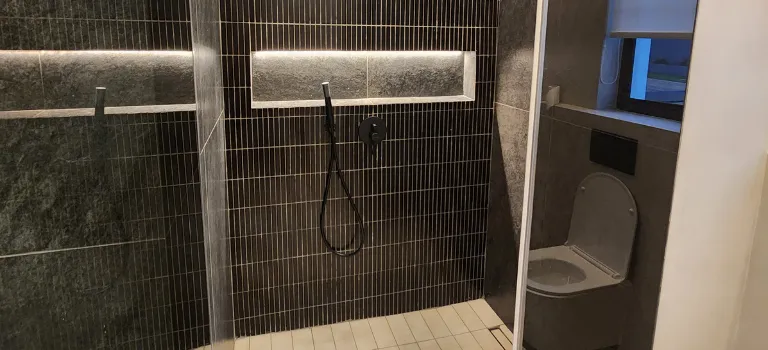
The most common layout mistakes in South African small bathrooms:
- The toilet is placed on the longest wall, dominating the sightline from the door
- The basin is positioned so the door swings into it when opened
- The shower is crammed into a corner with a hinged door that cannot open fully
- No consideration given to the swing radius of the door – eating into usable floor space
Reconfigure before you renovate
If your current layout fails you, a renovation is the right time to fix it, not to preserve it with new finishes. Relocating a toilet or basin typically involves moving a drain and supply pipe, which has a cost. But that cost is almost always lower than the regret of renovating a bathroom that still does not work.
The WC-last principle for small bathroom layouts
In a small bathroom, position the toilet where it is least visible from the entry point and least dominant in the room. This almost always means tucking it behind the door swing or into a corner far from the entrance. The shower or bath – the feature element – should take the most prominent position. The basin bridges the two.
Layout tip: If your bathroom is long and narrow (a common floor plan in South African homes), place the shower at the far end, the basin in the middle, and the toilet closest to the door. This sequence creates a natural, logical flow and puts the least attractive fixture in the least visible position.
Small Bathroom Design Ideas for Storage – Ending the Clutter for Good
Clutter is the fastest way to make a small bathroom feel even smaller. And clutter almost always comes down to inadequate storage, not a shortage of square metres. Here are the storage ideas that consistently deliver the biggest improvement to small bathroom design in South Africa.
Recessed shower niches: the best storage investment in a small bathroom
A recessed shower niche is built into the wall cavity between studs, taking up zero floor or wall projection. Done well, it holds shampoo, conditioner, soap, and a razor without a single bottle sitting on the shower floor or the edge of a sill. It also photographs beautifully – which matters if you are renovating to add value.
The niche should be tiled to match the shower walls and sized to hold standard product heights (typically 20–25 cm tall per shelf). Position it at chest height for convenience, not eye height, where it interrupts the tile pattern.
Floating vanities with deep drawers: not open shelves
Wall-mounted floating vanities serve two purposes in a small bathroom: they clear the floor, making the room feel more open, and they provide concealed storage without the visual bulk. The gap between the vanity and the floor reads as space, even when the vanity itself is full-depth.
Avoid open shelving under a basin in a small bathroom. It looks appealing in a showroom but becomes the most visible clutter-point in your daily life within weeks of moving in. Deep drawers with internal organisers are almost always the better choice.
Recessed mirror cabinets: double the function, zero the projection
A surface-mounted mirror cabinet projects 10–15 cm from the wall. A recessed mirror cabinet, set into the wall cavity to the same depth, projects nothing. In a bathroom where every centimetre of turning radius counts, that 15 cm is significant. The added storage in a recessed cabinet is a bonus.
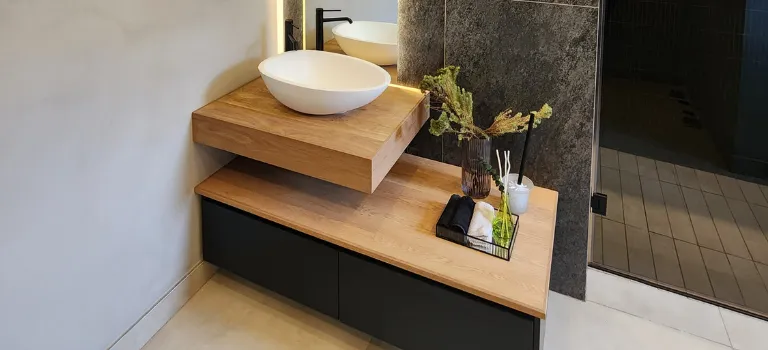
Storage tip: Vertical storage is underused in almost every small bathroom we encounter. A tall, slim tower cabinet, 30 cm wide, 180 cm tall, occupies minimal floor space and holds everything a family needs. Position it behind the door to use otherwise dead space.
Small Bathroom Design Ideas for Tiles That Make Rooms Feel Bigger
Tile selection has a greater impact on how large or small a bathroom feels than almost any other single decision. The wrong tile choice can make a perfectly proportioned room feel like a cupboard. The right choice can make a genuinely small space feel considered and generous.
Large-format tiles: the counterintuitive choice that works
The instinct in a small bathroom is to use small tiles. The opposite is usually correct. Large-format tiles, 600 x 600 mm, 600 x 1200 mm, or larger, have fewer grout lines. Fewer grout lines mean less visual interruption across the surface. Less visual interruption means the eye sees the floor or wall as a single, large, continuous plane.
This principle applies to both floors and walls. Carrying the same large-format tile from floor to wall, a technique called tile continuation, is one of the most effective small bathroom design ideas for making a compact space feel genuinely expansive.
Continuous floor-to-ceiling tiling in small bathrooms
One of the most impactful small bathroom design ideas for low-ceiling spaces is floor-to-ceiling tiling on at least one wall. When the eye is not interrupted by a paint-to-tile transition at mid-wall height, it travels upward continuously, and the ceiling reads as higher than it is. This is particularly effective on the wall facing the door, the first thing you see when entering.
Light tile colours with warm undertones
White and light tiles do expand the sense of space, but the particular shade of white matters enormously in South African homes. Pure brilliant white can read as cold and clinical under our strong natural light, particularly in south-facing bathrooms. Off-whites, linen tones, warm creams, and light sandy hues reflect light without the harshness and feel more appropriate to local conditions.
Tile consideration: Matte finishes are gaining ground over polished in South African bathroom design in 2026. They are more forgiving of water marks, easier to maintain, and create a softer, more luxurious feeling. They also work better with warm-toned lighting.
A single handmade feature tile as a focal point
In a small bathroom, a single feature element, a handmade tile on the shower back wall, a mosaic niche, and a decorative band at basin height create a focal point that gives the room a sense of intention and design quality. It draws the eye to a specific point rather than allowing it to scan the entire (small) room and arrive at its limitations.
Small Bathroom Design Ideas for Fixtures – Choosing Fittings That Recede
In a small bathroom, every fixture is a spatial decision. The wrong basin takes up 20 cm of turning radius you cannot afford. The wrong toilet adds visual bulk to the smallest possible room. The wrong shower door means you cannot open it without stepping back into the basin. Here is how to choose fixtures that work with your space rather than against it.
Wall-hung toilets: the single biggest layout improvement in a small bathroom
A wall-hung toilet with a concealed cistern (built into the wall cavity) is consistently one of the highest-return investments in a small bathroom renovation. It reclaims 15–20 cm of floor depth compared to a close-coupled floor-standing pan, frees the floor for easier cleaning, and visually reduces the bulk of the most imposing fixture in the room.
The concealed cistern is built into a wall-hung frame that sits inside a false wall, typically 20 cm deep. This can also double as a recessed shelf or storage niche above the cistern, a useful bonus in a space where storage is at a premium.
Frameless glass shower enclosures for small bathroom renovations
A framed shower door creates a visual boundary that divides the bathroom into two distinct zones – and in a small space, that division reads as two small spaces rather than one slightly larger one. A frameless glass enclosure removes that boundary. The shower reads as part of the room rather than a separate box within it, and the total floor area feels unified and larger.
For very small bathrooms, a wet room, where the shower area has no enclosure at all, just a floor gradient and a wall-mounted screen, is the most spatially generous option. It also eliminates the maintenance burden of glass cleaning and seal replacement.
Compact basins and wall-mounted taps
In a bathroom with limited floor space, basin projection – how far the basin extends from the wall – matters. A compact wall-mounted basin with a projection of 35–40 cm (versus the standard 50–55 cm) recovers significant turning space in front of the toilet and shower. Pair it with wall-mounted taps to keep the basin deck completely clear – another visual simplification that reads as more space.
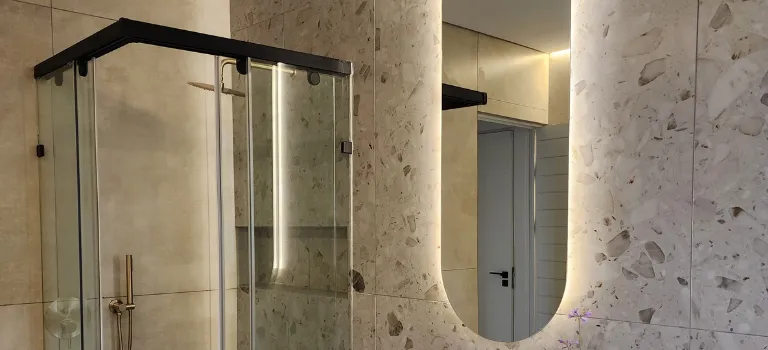
Fixture tip: Specify all your fixtures as a suite, with the same finish, design language, and brand range where possible. In a small bathroom, visual consistency across basin, toilet, shower fittings, and towel rails creates coherence, making the room feel considered rather than assembled piecemeal.
Small Bathroom Design Ideas for Lighting – The Most Overlooked Element
Lighting transforms small bathroom design more than almost any other variable, and it is the element most often treated as an afterthought. The standard South African small bathroom has a single ceiling downlight in the centre of the room that creates shadows on the face, fails to illuminate the shower, and makes the space feel institutional regardless of the quality of the finishes.
Layer your lighting in a small bathroom renovation
Every bathroom, regardless of size, benefits from three types of lighting:
- Ambient lighting: the overall illumination of the space, ideally from a warm-toned ceiling fitting that spreads light evenly rather than creating a hot spot
- Task lighting: specifically for the face at the mirror. This should come from beside the mirror, not above it – side-mounted fixtures eliminate the under-eye shadows that overhead lighting creates
- Accent lighting: low-level lighting that adds warmth and atmosphere – under-vanity strip lights, a lit niche, or a backlit mirror create layers that make a small bathroom feel considerably more generous
Mirrors and light: the combined multiplier effect
A large mirror in a small bathroom does two things simultaneously: it reflects available light back into the space, and it creates the visual impression of depth behind its surface. The most effective approach in a compact bathroom is a full-width mirror above the basin that extends to the side walls – or a mirror wall that reaches from basin height to ceiling. Both approaches dramatically amplify the perceived size of the room.
A backlit mirror – with an LED halo or strip behind the mirror panel – adds both ambient and task lighting in a single fixture and is one of the most space-efficient lighting solutions for a small bathroom.
Colour temperature matters: Specify bathroom lighting at 2700–3000K (warm white). Cooler light temperatures (4000K+) make skin tones look unflattering, and materials look harsher, particularly white tiles and chrome fixtures. Warm light makes everything and everyone look better.
Small Bathroom Design Ideas on a Budget – Where to Invest and Where to Save
Not every small bathroom renovation requires a full structural overhaul. If the layout works reasonably well, there are targeted investments that deliver a disproportionate improvement in how the space looks and feels, without the cost and disruption of a complete rebuild.
High-impact changes that do not require structural work
- Replace the mirror: a full-width, well-framed, or frameless mirror is one of the cheapest ways to make a small bathroom feel significantly larger
- Retile the shower: replacing old, grimy, or poorly grouted tiles in the shower enclosure alone refreshes the entire room – the shower is the focal point of most bathrooms
- Change the lighting: adding a side-mounted vanity light and a dimmer switch costs a fraction of a renovation but transforms the atmosphere entirely
- Replace tapware and hardware: updating basin taps, a towel rail, a toilet roll holder, and cabinet handles to a consistent finish – brushed brass, matte black, or brushed nickel – unifies the space and elevates the perceived quality
- Paint the ceiling a warm white or very light tone: a bright white ceiling in a room with dark or strongly coloured walls reads as higher and more open
Where to invest in a small bathroom renovation
If the budget is limited, spend it in this order:
- Waterproofing: non-negotiable and invisible; cutting corners here costs significantly more to fix later
- Tiles: the largest visual surface in the room; quality and selection matter more here than anywhere else
- Shower fixtures: the most-used element of the bathroom; invest in quality fittings that will last
- Vanity and basin: the second focal point; a well-chosen vanity elevates the whole room
- Lighting: often underbudgeted; the right lighting makes a R50 000 bathroom look like a R150 000 one
One of the most common small bathroom mistakes we see is clients spending their budget on premium floor tiles and then installing a single builder-grade downlight. The floor is on the ground. The light is what you see.
Small Bathroom Design in South Africa – Why Professional Design Pays
A small bathroom is, counterintuitively, one of the most technically demanding rooms to design well. The margin for error is smaller, the spatial decisions more consequential, and the number of competing requirements, waterproofing, ventilation, lighting, storage, fixture selection, and tile layout, greater per square metre than in almost any other room in the home.
The difference between a small bathroom that frustrates and one that genuinely works comes down to the quality of the design decisions made at the outset, before a tile is laid or a fixture is ordered. That is exactly what a professional interior design consultation delivers.
At Ahvia Designs, bathroom design is one of our most requested services. We work with clients across Gauteng, from compact en-suites in Sandton townhouses to full bathroom redesigns in Edenvale family homes, and we bring 3D visualisation, material specification, contractor management, and procurement to every project, regardless of scale.
Before you start: If you are planning a small bathroom renovation in Gauteng, book a design consultation before you approach a tiler or a plumber. The cost of getting the design right upfront is always lower than the cost of correcting decisions made without it.
Book Your Small Bathroom Design Consultation with Ahvia Designs
Whether you are starting from scratch or fixing a bathroom that has never quite worked, Ahvia Designs brings the design expertise, local knowledge, and full-service capability to make your small bathroom renovation exceptional, regardless of its size.
Ready to make the most of your bathroom space? Book a free initial consultation with Ahvia Designs today. Call 080 012 7449 or visit our website, and let’s design a bathroom that finally works for you.
Small Bathroom Design FAQ
Q: What are the best small bathroom design ideas for South African homes?
A: The highest-impact ideas are: resolving the layout before choosing fixtures, using large-format tiles with minimal grout lines, installing a wall-hung toilet, fitting frameless glass shower enclosures, and layering lighting with a side-mounted vanity mirror light.
Q: How can I make a small bathroom look bigger?
A: Use large-format tiles on both floor and wall, install a full-width mirror, choose a floating vanity, fit a frameless glass shower enclosure, and use warm layered lighting rather than a single overhead downlight.
Q: What tiles are best for a small bathroom?
A: Large-format tiles (600x600mm or larger) in off-white, linen, or warm neutral tones with minimal grout lines. Carrying the same tile from floor to wall amplifies the sense of space significantly.
Q: Is a wall-hung toilet worth it in a small bathroom?
A: Yes. A wall-hung toilet with a concealed cistern reclaims 15–20 cm of floor depth compared to a floor-standing pan, and visually reduces the bulk of the most dominant fixture in the room.
Q: How much does a small bathroom renovation cost in South Africa?
A: Small bathroom renovations in Gauteng typically range from R35 000–R120 000 depending on scope, tile selection, and fixture quality. A professional design consultation helps you allocate your budget to the changes that deliver the most impact.